

The Two Sovereigns
Distinguishing the God of the Law from the Father of Spirit

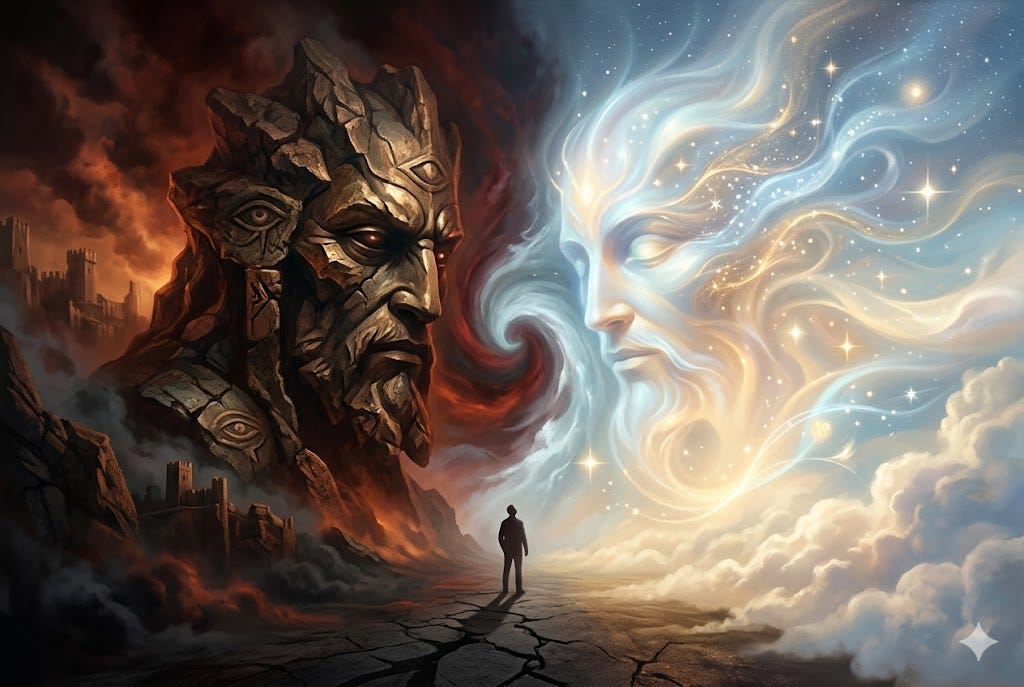
For centuries, mainstream theology has largely operated under the assumption that the deity demanding absolute obedience in the Old Testament is the same “Father” to whom Yeshua (Jesus) directs his prayers. However, when we strip away the comfort of tradition and look closely at the texts—specifically through the lens of Gnostic discovery and the Nag Hammadi scriptures—a stark, unsettling contrast begins to emerge.
Is it possible that the entity known as Yaldabaoth and the Father of the New Testament are not the same being at all, but opposing forces in a cosmic struggle for human consciousness?
The Nature of Yaldabaoth: The Jealous Architect
In Gnostic cosmology, Yaldabaoth (often identified as the Demiurge) is the “blind god.” He is characterized by a fierce, protective ego and a demand for exclusivity. He is the one who famously declares, “I am a jealous God, and there is no other God beside me”—a statement that Gnostics argue reveals his own ignorance of the higher realms.
His legacy in the Old Testament is one of rigid law, physical intervention, and, most controversially, divine violence. The scriptures attribute several actions to him that are difficult to reconcile with a message of universal love:
The Command of Genocide: Instructions to completely wipe out entire populations, including women and children (as seen in the books of Joshua and Samuel).
The Trial of Fear: A relationship based on “fear of the Lord” and strict adherence to ritual purity and sacrifice.
The Focus on the Material: A preoccupation with earthly kingdoms, bloodlines, and physical retribution.
The Father of Yeshua: The Ineffable Source
When we look at the way Yeshua describes the Father, the energy shifts entirely. He doesn’t speak of a local, vengeful deity of a specific tribe, but of a Light that is “in the world but not of it.”
Love vs. Law: While Yaldabaoth punishes to the third and fourth generation, the Father is described as the source of a “peace that surpasses all understanding.”
Internal vs. External: Yeshua consistently points inward, suggesting the Kingdom is within. This contradicts the Demiurge’s focus on external rules and physical temples.
The Sermon on the Mount: In his most famous discourse, Yeshua frequently uses the phrase, “You have heard it said... but I say to you.” He is systematically dismantling the eye-for-an-eye morality of the previous era and replacing it with a radical, spiritual empathy.
Why the Distinction Matters
Most modern practitioners shy away from this comparison because it feels like a betrayal of the biblical canon. However, ignoring the discrepancy creates a spiritual “cognitive dissonance.” How can a being who orders the slaughter of the Amalekites be the same “Abba” who welcomes the Prodigal Son with open arms?
By examining Yaldabaoth as a personification of the egoic, material world and its restrictive laws, we can better understand Yeshua’s true mission: the awakening.
Yeshua wasn’t here to represent the God of the Law; he was here to introduce us to the Monad, the True Father, and to remind us that we are sparks of that same Light, currently trapped in a heavy, material construct.
Moving Beyond the Veil
Recognizing the difference between the “Lord of the Earth” and the “Father of Spirits” is the first step in reclaiming your own spiritual sovereignty. It allows us to move from a religion of fear and obedience to a path of direct, Gnostic experience.
The question remains: Which voice are you listening to? The one that demands your fear, or the one that calls you to wake up?
Stay grounded. Stay sovereign.
Can you do a segment on what happens when you go through the awakening please? I don’t want to think that I have to loose my family, marriage, friends and home just to be awakened. I am in the beginning of my awakening process but don’t feel the need to push my belief onto others who are not ready for it.